
How to Get TRV for HSBC Premier Credit Card Using Stocks & Direct Mutual Funds
Chasing ₹50 lakh TRV for HSBC Premier? There’s a route most people don’t know about. 💰
HSBC Premier is one of the most sought-after super premium credit cards in India right now — and for most people, the thing standing between them and the card is a single number: eligibility.
Here’s the good news. One of the two qualifying routes is far more within reach than it first looks, and the best part is that it doesn’t ask you to bring in a single rupee of fresh money. You may already be holding everything you need. Let me walk you through exactly how I did it.

A quick note on terminology: You’ll see both TRV (Total Relationship Value) and TRB (Total Relationship Balance) used for the HSBC Premier requirement. They mean the same thing and are used interchangeably — this article uses them interchangeably too.
Not financial advice. Everything in this article is based on my own personal experience and what is working as of September 2026. This is a personal finance decision that depends entirely on your own circumstances. Please do your own research, consult a qualified financial adviser or stock-broking expert, and try anything only at your own risk. I am not a qualified financial adviser — I am simply sharing what I did.
The Two Ways to Get HSBC Premier
So how do you actually qualify? There are broadly two doors in:
| Route | Requirement |
|---|---|
| Salary account route | ₹3 lakh net-in-hand monthly salary credited to an HSBC Premier salary account |
| Relationship route | Maintain ₹50 lakh Total Relationship Value (TRV) with HSBC |
Four Ways to Build ₹50 Lakh TRV
The nice thing here is that you don’t have to hit ₹50 lakh with any one instrument. You can mix and match — a bit here, a bit there — until it adds up:
- Balance in your HSBC Savings Account
- Fixed Deposits with HSBC
- Mutual funds purchased through HSBC — these will be Regular mutual funds, with HSBC as your MF agent. You can buy from most popular AMCs, not just HSBC’s own funds.
- Assets held in an HSBC Demat account — the most interesting and creative route, and the focus of this article.
The current market value of all assets parked in your HSBC Demat account counts towards the ₹50 lakh TRV requirement.
What You Can Park in an HSBC Demat Account
Three common asset types qualify:
- 📈 Stocks / shares
- 📊 ETFs
- 💼 Mutual funds held in demat form
And here’s where it gets interesting, because there are two very different ways to get these assets into your HSBC demat account. One is slow and expensive. The other is fast and free. Most people only hear about the first one.
Option 1: Buy fresh through HSBC (slow and costly)
You can buy new stocks, ETFs or mutual funds through HSBC. This means contacting your HSBC relationship manager, filling physical or PDF forms, and placing your buy request through them.
The problems with this route:
- No online execution. You cannot buy or sell online in seconds the way you can with Zerodha, Groww and similar platforms (more on why, below).
- Manual requests take days. Placing a buy or sell request through your RM can take 5–7 days or more — just to execute a single trade.
- Higher charges. With HSBC acting as your broker, brokerage and associated charges will most likely be higher than new-age brokers.
Option 2: Transfer what you already own (fast and free)
This is what most people quietly end up doing — and it’s exactly what I did.
Instead of buying anything new, you simply move existing stocks and ETFs from your regular demat account — Zerodha, Groww, whatever you use — across to your HSBC demat account. In practice, the assets people choose to move tend to be long-term holdings: a slice of the portfolio they’re happy to sit on, and won’t need to sell in a hurry. Nothing gets sold. It just changes address.
The Part Most People Get Wrong: Direct Mutual Funds
Now here’s the bit that trips almost everyone up — and it’s the reason I wanted to write this article.
Most people believe the only way to build TRV through mutual funds is to switch into Regular plans via HSBC — handing back the lower expense ratio of your Direct funds in the process. That belief costs people real money over time.
If you hold mutual fund units purchased through Zerodha Coin — or any platform where units are held in demat form — you can transfer them to your HSBC Demat account, and they count towards your Premier TRV. Even if they are Direct Mutual Funds.
📊 Why does this work? When you buy Direct mutual funds through Coin, your units sit in demat form — not in the usual statement-of-account format most people are used to. And anything in demat form can be moved.
🔄 What that enables: those demat MF units can be transferred to your HSBC demat account using the physical Delivery Instruction Slip (DIS) method — exactly the same process as moving shares from one demat account to another.
⏱️ How long it took me: the entire process took just 4 days including DIS courier transit time. The value reflected in my HSBC Demat account the very next day after processing.
💡 The best part: this is a transfer, not a redemption. No capital gains event. No exit load. Your money stays invested throughout. 👍
If you want to build HSBC Premier TRV through the mutual fund route without moving to Regular plans, this is probably the easiest way. Tried and tested — and it works. ✳️😊

Step-by-Step: Transferring from Zerodha to HSBC Demat
Good news: whether you’re moving shares, ETFs or demat mutual funds, the process is exactly the same. Learn it once and it works for all three.
Here’s the exact sequence I followed, using Zerodha as my source account. If you’re with a different broker, don’t worry — the steps will look almost identical, just with their forms instead of Zerodha’s.
Why DIS and not an online transfer: Zerodha’s demat account is with CDSL, while the HSBC demat account is with NSDL. For a cross-depository transfer like this, the Delivery Instruction Slip route is the most straightforward path.
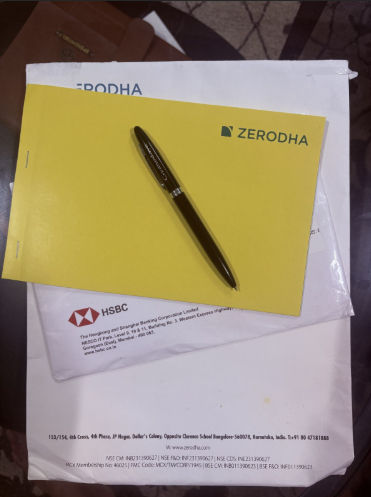
Step 1 — Get a DIS booklet from Zerodha
- Download the Requisition Form / Letter for New Delivery Instruction Slip Book from Zerodha: Download the DIS request form
- Print the form, fill it in, and courier it to Zerodha at the address below.
- Full details of this process are on Zerodha’s official support page: Where can I get a DIS booklet?
Step 2 — Add your HSBC Demat account as a beneficiary
- Before you can transfer, HSBC’s demat account must be registered as a beneficiary on the CDSL side. Zerodha’s guide covers this: Adding a beneficiary on CDSL →
Step 3 — Fill in the Delivery Instruction Slip
- Complete the DIS with full details, including the ISIN of every stock, ETF and Direct Mutual Fund you want to move. Getting the ISIN right matters — an error here will hold up the transfer. How do I fill in a DIS slip? →
Step 4 — Courier the completed DIS to Zerodha
Send the filled DIS to the same Zerodha Customer Support Centre address in Step 1.
Step 5 — Complete verification
Once Zerodha receives your DIS slip, the transfer request is verified by call or email for security purposes. This happens within 48 working hours of receiving the documents.
If the transfer value exceeds ₹5 lakh, a video verification of all account holders is required. The transfer is only processed after verification is successful — so build this into your timeline.
Important: You Can't Sell HSBC Demat Holdings Online
This is the single most important practical limitation to understand before you move anything — and it applies to everything you park in an HSBC demat account, mutual funds included.
The missing trading account
HSBC does not currently provide a trading account alongside its demat account. Without a trading account, you cannot buy or sell your holdings online.
It wasn’t always this way. HSBC previously had a tie-up with ICICI Securities, and under that arrangement HSBC demat account holders could buy and sell stocks, ETFs and other securities online, just like any other demat account. That partnership was discontinued around a year ago — and since then, HSBC demat holders have had no online trading facility.
HSBC relationship managers have been saying a trading account will be provided “soon.” But it has now been more than a year with nothing. My own RM currently says HSBC customers will get a trading account by December 2026 — but I wouldn’t rely on that timeline.
My expectation: I do believe HSBC will eventually provide a trading account to demat account holders, because that’s how they’d earn from this business. But I cannot be sure about the timeline. So plan on the assumption that anything you transfer to an HSBC demat account will need the manual selling process — and that this takes 5–7 days.
This applies to demat mutual funds too
An important point that’s widely misunderstood: demat mutual fund units held in an HSBC demat account cannot be sold through the AMC’s app or website either. I found this out directly.
Just like stocks and ETFs, to sell demat mutual fund units held with HSBC you have two options:
- Contact your RM and place a manual sell request, or
- Transfer the units back to your regular demat account (Zerodha, etc.) using the physical DIS method, and then sell them there
Either way, expect a 5–7 day process. There is no instant online exit while the assets sit in the HSBC demat account.
What this means for your planning
So here’s my rule of thumb: only move things you’re genuinely happy to leave parked for a while — those long-term holdings you’re not going to touch. Anything you might need to cash out quickly? Leave it right where it is, in your regular demat account.
The DIS transfer route remains the cheapest and cleanest way to build TRV without redeeming — no capital gains event, no exit load. Just go in with clear eyes about the liquidity trade-off while the assets are parked with HSBC.
What Your RM Will Tell You — and Why It's Wrong
Here’s something you should brace for. Talk to enough people who’ve tried this, and you’ll hear the same story — their HSBC relationship manager flatly told them it can’t be done. Usually some version of:
- ❌ HSBC Premier cannot be obtained using demat holdings
- ❌ Zerodha shares cannot be transferred to an HSBC demat account
- ❌ Direct mutual funds, even in demat form, cannot be transferred to an HSBC demat account
None of these are true, based on my own practical experience — I have successfully done this.
What is true is narrower than it sounds: your RM will open the HSBC demat account for you, but that’s where their help ends. They won’t guide you through moving your existing shares, ETFs or mutual funds into it — that part is entirely on you.
And it helps to understand why. There’s a quiet incentive at work. Bank staff would much rather you shift into Regular funds, because that’s what earns them commission. Moving your Direct funds in demat form from one account to another puts nothing in their pocket — so it’s simply not a conversation they’ll ever start. That doesn’t make it impossible. It just makes it something you have to know to ask for.
But changing your demat account is your right, and it is permitted by the regulators. I did it for myself and it worked exactly as described.
Risks and Cautions
Please read this carefully before acting on anything in this article.
Everything described here is based on my own personal experience and knowledge, and is working as of the date of writing. HSBC may change these rules at any time in future, potentially without notice.
More importantly, this is a personal finance decision and is highly specific to the individual executing it. Moving assets between demat accounts, and choosing where to hold your investments, has implications that depend entirely on your own financial situation.
Do your own research, consult a qualified financial adviser or a qualified stock-broking expert, and try anything only at your own risk. I am not a qualified financial adviser — I am simply sharing my own experience.
Frequently Asked Questions
Accordion Content
The alternative route is maintaining a ₹50 lakh Total Relationship Value (TRV), also called Total Relationship Balance (TRB), with HSBC. This can be built by combining savings account balance, fixed deposits, mutual funds purchased through HSBC, and the market value of assets held in an HSBC demat account.
Yes. The current market value of all assets parked in your HSBC demat account — stocks, ETFs and mutual funds held in demat form — is counted towards the ₹50 lakh TRV requirement.
Yes. Zerodha’s demat account is with CDSL and HSBC’s is with NSDL, so the transfer is done using a physical Delivery Instruction Slip (DIS). You request a DIS booklet from Zerodha, add HSBC as a beneficiary, fill in the DIS with the ISIN of each holding, and courier it back to Zerodha for processing.
Yes, provided the units are held in demat form — for example, Direct funds bought through Zerodha Coin. These can be transferred using the same DIS process as shares, and they count towards your TRV. You do not need to switch to Regular plans.
No. Moving units between demat accounts is a transfer, not a redemption. There is no capital gains event and no exit load, and your money remains invested throughout. That said, please confirm your own tax position with a qualified adviser.
In my case the entire process took 4 days including DIS courier transit time, with the value reflecting in the HSBC demat account the very next day after processing. Add time for verification — Zerodha verifies by call or email within 48 working hours, and transfers above ₹5 lakh require video verification of all account holders.
No. HSBC does not currently provide a trading account alongside its demat account, so nothing held there can be sold online — this applies to stocks, ETFs and demat mutual funds alike. To sell, you either place a manual request through your relationship manager, or transfer the holdings back to your regular demat account using the DIS method and sell there. Either route takes around 5–7 days. HSBC previously allowed online trading through a tie-up with ICICI Securities, but that was discontinued around a year ago.
Relationship managers will generally only open the demat account and will not assist with transferring existing holdings into it. There is also a commission incentive to move customers into Regular mutual funds. Transferring Direct funds in demat form between demat accounts is permitted by the regulators, and is your right as an investor.
This article is not financial advice. It describes my own personal experience and what was working at the time of writing. Rules, processes and eligibility criteria may be changed by HSBC, Zerodha or the depositories at any time without notice. Do your own research, consult a qualified financial adviser or stock-broking expert, and act only at your own risk.
21 Comments on “How to Get TRV for HSBC Premier Credit Card Using Stocks & Direct Mutual Funds”
very comprehensive article, all aspacts covered
Thank you
Very nice step by step guidance.Thank You for your sincere effort
Welcome 🙂
Brilliant article. This is a clean playbook to follow for those planning to move their demat for Premier TRV.
Thank you 🙂
Can we do a ₹50 lakh Fd to get the card? Once done, can we break the FD or do we need to mantain the FD throughout?
Once transferred will the daily NAV continue to reflect on MF units held with HSBC DMAT?
yes
You have to maintain the relationship of 50 lac in any form. You can break the FD but then maintain 50 lac in savings account!
yes
I have mutual fund holdings in SOA (statement of account) form. At the moment, they are not in dematerialised form. Can I get them dematerialised through HSBC team directly into my HSBC demat account?
Please help me with this question
No as far as I know, they do not dematerialised SOA mutual funds.
Yes
Any further clue?
Do you get any monthly/qtly statement which positively confirms that the direct MF or ETF units were included in the TRB calculation?
Can this be done while opening a joint HSBC Premier account? Husband and wife both having MFs in their respective Zerodha accounts, can they both transfer the same into joint HSBC Premier account?
While adding HSBC as beneficiary in HSBC, how to get BO ID and buyer PAN
While adding HSBC as beneficiary in CDSL, how to get BO ID and buyer PAN.
do i need to contact my RM to get by BO ID and also PAN number should be mine or HSBC’s ?
What about the brokerage while selling stocks/MF from HSBC demat? And is any fee required for the tansfer? Overall I want to know how much am I losing in whole stock/MF life cycle(transfer to sell) compared to if keep it unmoved in Zerodha?