
Axis Atlas Credit Card Review 2026 — Still Worth It After Accor Exit?
Let’s address the elephant in the room first.
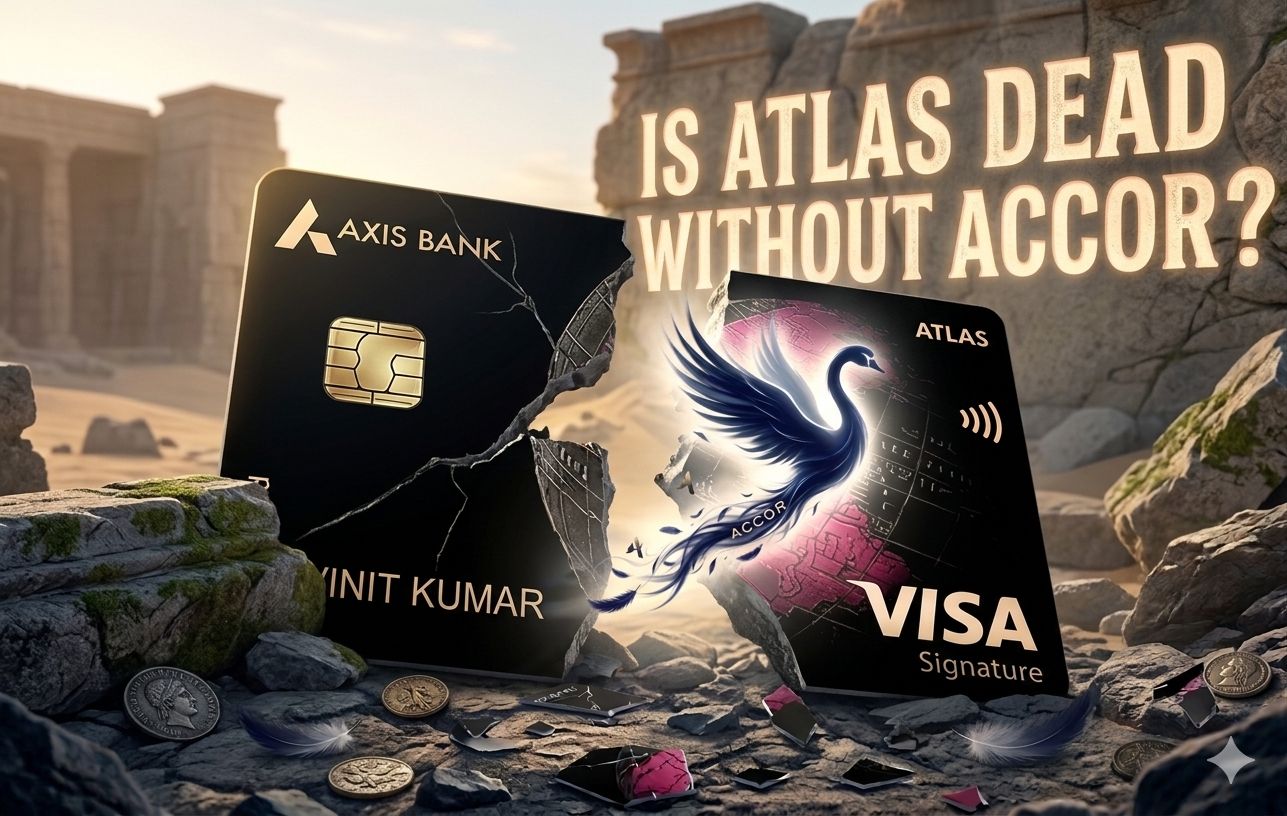
Accor ALL — the partner that made the Axis Atlas Credit Card arguably the most exciting travel card in India — is gone. For a card that built much of its identity around that ₹2-per-point Accor valuation, that’s a significant blow.
But before you cancel or downgrade, let’s actually run the numbers. Because the full picture of the Atlas card in 2026 is more nuanced than “Accor left, card is dead.”
What Kind of Card Is Axis Atlas, Really?
The Axis Bank Atlas Credit Card is a premium travel credit card — but here’s what most people miss: it’s not just a travel card.
Yes, it rewards you handsomely for flights, hotel bookings, and travel-related spends. But the base reward rate applies broadly across both online and offline categories. So whether you’re swiping at a restaurant, paying school fees, or checking out at a hotel, you’re earning meaningfully.
That’s the core proposition of Atlas: a high base reward rate that doesn’t restrict you to a narrow set of categories.
Most super-premium credit cards in India offer higher valueback only on specific spend buckets — travel portals, dining, or online shopping. Atlas gives you a floor of 4% across nearly everything (with exclusions we’ll get to). Very few cards, premium or otherwise, match that.
The base reward rate across spend categories — both online and offline — starts at 4% and can reach 5.6% or higher depending on how much you spend and how you redeem. Even after Accor’s exit, that earn rate remains one of the strongest in its category. Super-premium cards charging ₹10,000–₹20,000 in annual fees often don’t deliver this kind of across-the-board reward rate.
For a detailed breakdown of all features, fees, and benefits, check out the full Axis Atlas Credit Card Review on SpendWisely.
What's Left After Accor's Exit?
Air India Maharaja Club
Air India’s Maharaja Club has quietly become a more practical loyalty program after the airline reduced points requirements on a large number of domestic economy routes. For the average Indian traveller who flies domestic, this actually matters.
Conservative and practical valuation: 1 Air India Mile ≈ ₹1.
Not ₹2. But real, usable value — not the kind that sounds great on paper but never gets redeemed.
ITC Hotels — ITC One Green
ITC Hotels’ loyalty program offers a flat 1 Point = ₹1 value across properties. Clean math, no confusing tier multipliers. Their network covers most major Indian cities, though it skews premium and luxury — Welcomhotel, ITC Grand, ITC Rajputana, and similar.
If you stay at ITC properties for business or leisure, this is genuinely valuable. If your hotel preferences run budget or mid-segment, this partner won’t move the needle much.
Neither Can Match Accor — Let's Be Honest
Accor’s exit effectively halved the point valuation — from ₹2 to ₹1. That’s a hard fact and nobody should minimize it.
But ₹1 per point is still real value if your earning rate is strong enough. And with Atlas, it still is.
The Transfer Advantage Is Still Intact
Here’s what gets lost in the post-Accor noise: the transfer mechanics haven’t changed.
Both ITC Hotels and Air India sit in Group B, meaning you can transfer up to 1,20,000 Edge Miles per year at a 1:2 ratio — giving you 2,40,000 ITC Points or Air India Miles.
At ₹1 per point: that’s ₹2.4 Lakhs in annual redemption potential just from the yearly transfer cap.
That’s not a dead card. That’s still serious firepower for high spenders.
Base Reward Rate: Still Unmatched in Its Class
Atlas earns 2 Edge Miles per ₹100 spent, which converts to 4 partner points — approximately 4% valueback across most spends.
To put this in perspective: 4 airmiles or hotel points per ₹100 on offline spend is unmatched even in super-premium categories of credit cards. You may find higher cashback or valueback on specific online categories with other cards, but for a flat rate covering both online and offline broadly, Atlas still stands alone.
Add milestone bonuses and the effective reward rate across categories crosses 5%. Even the most super-premium credit cards don’t deliver this kind of across-the-board return.
Exclusions to note: Fuel, government transactions, insurance wallets, utilities, and jewellery don’t earn rewards. If a significant chunk of your monthly spend falls here, your effective valueback will be lower.
The Valueback Math at Different Spend Levels
Here’s the full picture with milestone bonuses and the ₹5,900 annual fee factored in.
At ₹3 Lakhs Annual Spend
- Milestone bonus: 2,500 Edge Miles = 5,000 partner points = ₹5,000
- Milestone valueback: 1.67%
- Base valueback: 4%
- Fee impact: ~1.97%
- Net valueback: ~3.7%
On direct hotel, airline bookings, and Axis Travel Edge spends, add 6%: ~9.7% total
The fee bites harder at this level. Borderline proposition.
At ₹7.5 Lakhs Annual Spend
- Milestone bonus: 7,500 Edge Miles (2,500 at ₹3L + 2,500 at ₹7.5L + 2,500 against fee payment) = 15,000 points = ₹15,000
- Milestone valueback: 2%
- Base valueback: 4%
- Fee impact: ~0.79%
- Net valueback: ~5.21%
On travel direct spends: ~11.21% total
This is the sweet spot. The fee dilutes minimally and milestones compound well.
At ₹15 Lakhs Annual Spend
- Milestone bonus: 15,000 Edge Miles = 30,000 points = ₹30,000
- Milestone valueback: 2%
- Base valueback: 4%
- Fee impact: ~0.39%
- Net valueback: ~5.61%
On travel direct spends: ~11.61% total
At this spend level, even without Accor, Atlas is hard to beat on raw reward rate across categories.
Three Unique Benefits That Often Get Overlooked
Beyond the reward math, Atlas has three specific advantages that no other card in this segment currently replicates:
1. Accelerated Rewards on Offline Hotel Payments
This is genuinely rare. Atlas is the only credit card in India that gives accelerated reward points on offline payments to hotels — meaning direct payments at the property during check-in, check-out, hotel dining, spa, and similar charges.
Most cards accelerate rewards only on online hotel bookings through portals. Atlas rewards you for the actual spend at the property, which is where a significant part of hotel expenditure actually happens many times.
2. Best Credit Card for School and College Fee Payments
As of 2026, almost all credit cards have either stopped rewarding education spend entirely or added quiet exclusions.
Atlas still gives full valueback on education fee payments made via third-party apps like EduSprint.
HDFC Bank’s cards still reward education spend — but only on direct payments to institutions. Pay through EduSprint or CRED? No rewards with HDFC. Atlas has no such restriction, making it the most practical option for families with school or college fees running into lakhs annually. For a family paying ₹2–3 Lakhs a year in education fees, the reward loss on other cards is real money.
3. Guest Access at Airport Lounges
Atlas is one of the very few non-premium credit cards that extends lounge access to accompanying guests — at both domestic and international airport lounges.
Most cards at this fee range give lounge access only to the primary cardholder. If you regularly travel with your family or colleagues, this is a meaningful benefit that you’d otherwise need a significantly more expensive card to access.
The Risk You Cannot Ignore
None of the above math works if Axis reduces the transfer ratios across the board — and I genuinely believe that’s a near-term risk.
Accor already walked. These changes typically arrive with one month’s notice, sometimes less. If you’re holding Atlas and planning to maximize transfers, plan it now considering your usual travel plans while the current ratios hold. Don’t assume the 1:2 Group B structure survives another 12–18 months unchanged.
This is the single biggest caveat with Atlas in 2026: the card’s value is still attractive right now, but its devaluation risk is also high. I strongly believe that the next set of devaluation in the Axis Bank Atlas Credit Card is not months, but just the few days away.
Looking for a Safer Alternative? HSBC TravelOne Is the Closest Alternative.
If the devaluation risk on Atlas makes you uncomfortable — or if you’re building a two-card travel stack — there’s one card I’d point you to right now: the HSBC TravelOne Credit Card.
And here’s why it matters in this context: while other banks have been busy devaluing programs and removing partners, HSBC has been doing the opposite — adding benefits, improving the TravelOne ecosystem, and building one of the most robust partner networks in the non-super-premium segment.
👉 Apply for HSBC TravelOne Credit Card Read the full HSBC TravelOne Review on SpendWisely for a detailed breakdown.
The Partner Network Is Simply Unmatched at This Fee
TravelOne offers 1:1 transfer to a remarkably wide list of airlines — Air India, British Airways, Singapore Airlines, Qatar Airways, Etihad, Air France-KLM, Japan Airlines, Turkish Airlines, United Airlines, Qantas, Thai Airways, and more. On the hotel side: Accor, Marriott Bonvoy, IHG One Rewards, and Wyndham — all at 1:1.
Having Accor AND Marriott AND IHG in a single card at this fee range is extraordinary. Atlas, even at its peak with Accor, couldn’t offer this diversity.
No Annual Transfer Cap
Atlas has a Group B cap of 1,20,000 Edge Miles per year. TravelOne imposes no such hard annual cap on transfers — which means high spenders aren’t artificially limited in how much value they can extract.
Reward Structure
- 4 Reward Points per ₹100 on flights, travel aggregators, and foreign currency spends
- 2 Reward Points per ₹100 on all other eligible spends
- 10,000 bonus Reward Points on annual spend above ₹12 Lakhs
- All transfers at 1:1 ratio directly through the HSBC India mobile app — instant, no waiting
The HSBC Rewards Marketplace Advantage
Booking through HSBC’s travel platform gives you up to 6x points on hotel bookings and 4x on flights. When you combine that earn rate with 1:1 partner transfers, you’re looking at potential returns of 16–24% on travel bookings — on top of which, you can still double-dip with OTA discount offers from Yatra, EaseMyTrip, Cleartrip, and Paytm Travel (up to 15–20% off). And if you redeem the points to Accor, the effective valueback on hotels can be as high as 50% which is unbelievable. Even flights can fetch more than 32% valueback.
Complimentary Chauffeur-Driven Airport Transfers — A Genuinely Premium Touch
In 2026, HSBC added 4 complimentary chauffeur-driven airport transfers per year for TravelOne cardholders — in a Toyota Hycross or equivalent premium SUV. That’s a benefit usually reserved for cards charging ₹10,000+ in annual fees. At ₹4,999 (+ GST), getting four premium airport cab rides worth ₹8,000–₹10,000 in total is a standout value-add.
Lounge Access
6 complimentary domestic lounge visits + 4 international lounge visits per year via Mastercard LoungeKey — comfortably covering most travellers’ annual needs.
Annual Fee & Waiver
The joining and renewal fee is ₹4,999 + GST (≈ ₹5,898 all-in) — marginally cheaper than Atlas. Spend ₹8 Lakhs in the preceding year and the annual fee is waived entirely.
Low Devaluation Risk — For Now
This is the crux. HSBC has been expanding TravelOne, not shrinking it. The addition of chauffeur transfers in 2026, the broad and growing partner list, and HSBC’s global standing as an issuer all point to a bank that is currently investing in this card — not looking to cut benefits. That doesn’t mean devaluation will never happen, but right now TravelOne carries significantly less structural risk than Atlas.
TravelOne vs Atlas — Which Should You Pick?
| Feature | Axis Atlas | HSBC TravelOne |
|---|---|---|
| Annual Fee | ₹5,900 | ₹5,898 |
| Fee Waiver | No | Yes (at ₹8L spend) |
| Base Earn Rate | 4% (broad) | 2% (broad), 4% (travel), 8% if redeemed on Accor |
| Transfer Partners | 22 but strict transfer limits | 15+ airlines, 4+ hotel chains |
| Transfer Cap | 1,20,000 Miles/year (Group B) | No hard cap |
| Partner Valuation | ₹1/point (currently) | ₹2.1/point with Accor, ₹1/point + premium airline potential |
| Devaluation Risk | High | Low |
| Offline Hotel Earn | Accelerated | Standard |
| Education Fee Rewards | Yes (via EduSprint) | No |
| Guest Lounge Access | Yes | No (primary only) |
| Chauffeur Transfers | No | 4/year |
| Accor as Partner | No | Yes (1:1) |
| Marriott / IHG | No | Yes (1:1) |
My take: If you want a higher flat earn rate across all categories and you pay school fees or stay at offline hotel properties frequently — Atlas still has an edge. But if you want a card with a better long-term outlook, a richer partner ecosystem, and lower risk of waking up to a devaluation notice — TravelOne is the smarter choice right now.
And if you do not have Atlas Credit Card, then HSBC Travel One is the only option as Axis Bank has stopped issuing new Atlas Credit Card.
The ideal setup for a serious travel optimizer: hold both cards for as long as Atlas’s current ratios last, then let Atlas go when the devaluation hits.
Final Verdict on Axis Atlas — Not Dead, But on Borrowed Time
Keep Atlas if:
- You spend ₹7.5 Lakhs or more annually on eligible categories
- You have meaningful offline hotel or flight spend where the 6% accelerated rate applies
- You pay school/college fees and want to keep earning on that spend
- You travel with family and value guest lounge access
- You can actively transfer to ITC or Air India while the rates hold
Reconsider Atlas if:
- You spend under ₹3 Lakhs a year — the fee impact makes this a tough sell
- Most of your spend falls in excluded categories
- You’re not in a position to actively manage and redeem transfers
- You want a card you can rely on for the next 2–3 years without constantly watching for devaluation news
Atlas isn’t dead. But it’s running on borrowed time. Use it hard while it’s good, and build your longer-term travel card strategy around something more stable — like TravelOne.
Frequently Asked Questions
Accordion Content
Yes, no joining fee and no renewal fee ever.Yes — particularly for spenders above ₹7.5 Lakhs per year. The net valueback is ~5.2% even without Accor, through ITC Hotels and Air India Maharaja Club. The card’s strong base rate across categories also makes it relevant beyond just travel spend. However, the risk of further devaluation is real.
After Accor’s exit, the useful Group B partners are Air India Maharaja Club, ITC Hotels’ ITC One Green program and Flying Blue. All these transfers have Edgemile transfer rate at 1 Edge Mile = 2 partner points, with an annual Group B cap of 1,20,000 Edge Miles. In Group A (with a cap of 30,000 Edge Miles per calandar year), there are many useful transfer-partners like Krishflyer (Singapore Airlines), Turkish Airline, JAL etc
Atlas earns 2 Edge Miles per ₹100 on most spends, converting to 4 partner points — approximately 4% valueback. With milestone bonuses at higher spend levels, this rises to 5.6%. Exclusions include fuel, government, wallets, utilities, and jewellery.
Yes, for most users. Atlas gives full rewards on education fee payments via third-party apps like EduSprint. HDFC Bank cards restrict rewards to direct institutional payments only — making Atlas uniquely valuable for this category.
Yes. It is one of the few non-premium credit cards in India offering airport lounge access for accompanying guests, at both domestic and international airports.
HSBC TravelOne Credit Card is the strongest alternative in the non-super-premium segment. It offers a significantly wider partner network (15+ airlines including Singapore Airlines, British Airways, Qatar Airways, plus Accor, Marriott, and IHG at 1:1), no annual transfer cap, complimentary chauffeur airport transfers, and a much lower devaluation risk as of 2026. Apply here.
₹4,999 + GST (approximately ₹5,898 all-in). The annual fee is fully waived if you spend ₹8 Lakhs in the preceding year.
The risk is real and near-term. Transfer ratio reductions are possible with minimal notice. It’s advisable to maximize transfers while current ratios hold, and consider building your long-term travel card strategy around a more stable option.